A Catholic Cathedral in the Heart of Istanbul: My Visit to St. Antoine Church
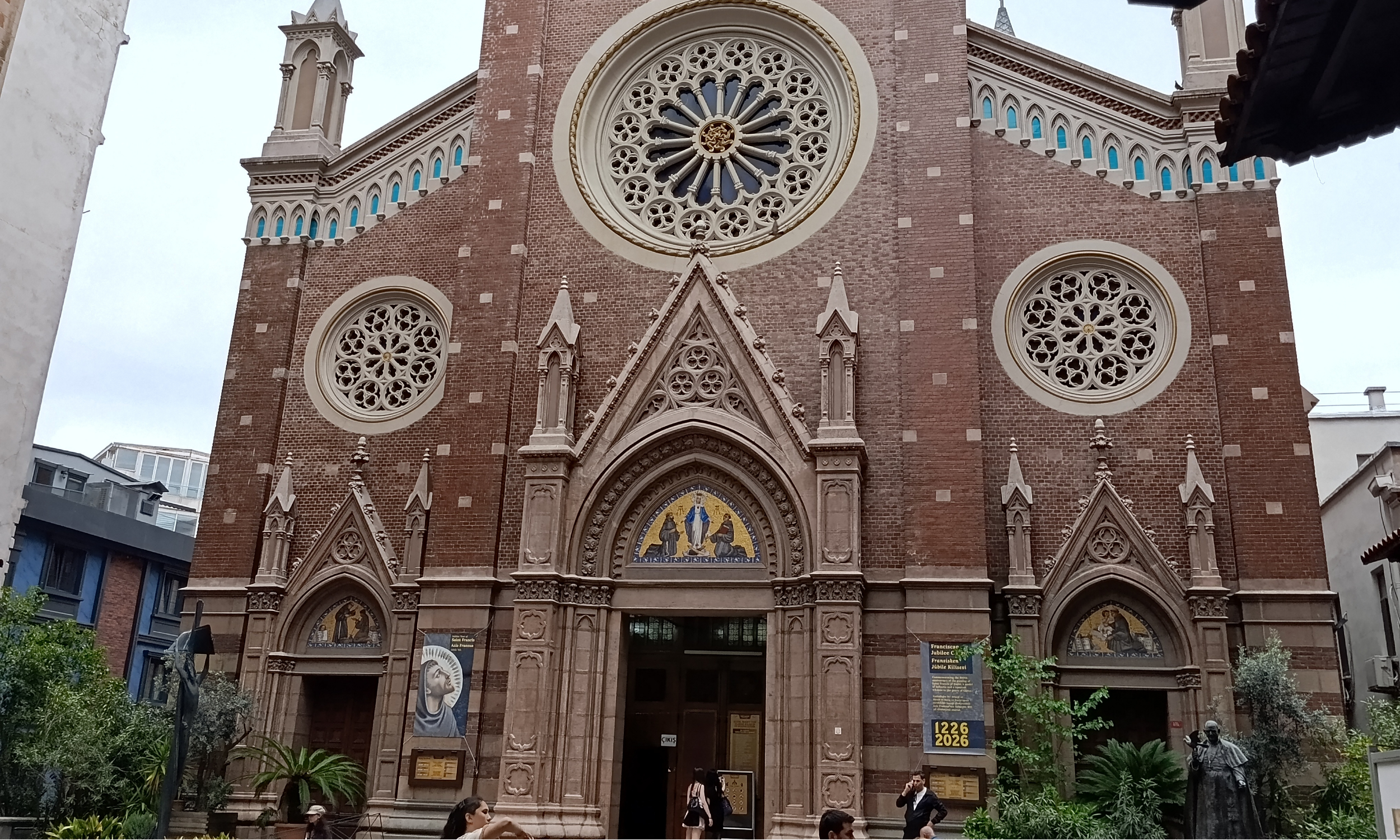
Walking down Istiklal Caddesi on a busy afternoon, I was not expecting to find a cathedral. I was looking for a café, maybe a bookshop, definitely not a neo-Gothic church the size of a small basilica rising in vivid red brick from one of the most frenetic pedestrian streets in the world. But there it was, St. Antoine, flanked by six-storey apartment buildings, quietly magnificent and almost entirely ignored by the crowds rushing past.
I stopped. I went in. It turned out to be one of the most memorable moments of my time in Istanbul.
A Church With a Long History in the City
St. Antoine, officially the Church of Saint Anthony of Padua, or Sant'Antonio di Padova in Italian, has been part of this neighborhood since 1725, when it was established to serve the many Italian and Catholic European families who had settled in the Ottoman Empire. Istanbul's Beyoğlu district, historically known as Pera, was long the beating heart of the city's cosmopolitan foreign community, and the church was a natural anchor for that life.
The original building didn't survive into the modern era. In the early 20th century, it was demolished to make way for a new tramway line, a fate that feels almost poetically fitting in Istanbul. But the Italian community here was sizable and determined at the turn of the century, there were around 40,000 Italians living in the city, and they weren't about to lose their church. Construction on the new building began in 1906, designed by Giulio Mongeri, a Levantine architect born in Istanbul himself and a teacher at the city's Academy of Fine Arts. By 1912, the church was open for worship again, and the building you see today is essentially what Mongeri gave the city, a confident, beautiful example of Italian neo-Gothic and Tuscan-Lombard architecture that somehow looks completely at home here.
What to Expect When You Arrive
The entrance to St. Antoine sits back slightly from the street, framed by those two large apartment buildings on either side which were themselves built by the church community specifically to generate income and fund the building's construction. They hold the distinction of being the first reinforced concrete buildings on Istiklal Caddesi. Before you even step inside, there's history right there in the walls around you.
In the courtyard, just before the main doors, you'll find a statue of Pope John XXIII. This is not a random placement. John XXIII served as the Vatican's apostolic delegate to Turkey for a decade, and he preached regularly at this very church. He reportedly loved Istanbul deeply, spoke Turkish fluently, and earned the nickname "The Turkish Pope" among locals. Standing in that small courtyard, it's a genuinely touching detail, a pope shaped in part by this city, commemorated on its most famous street.
Inside: Quiet, Beautiful, Surprising
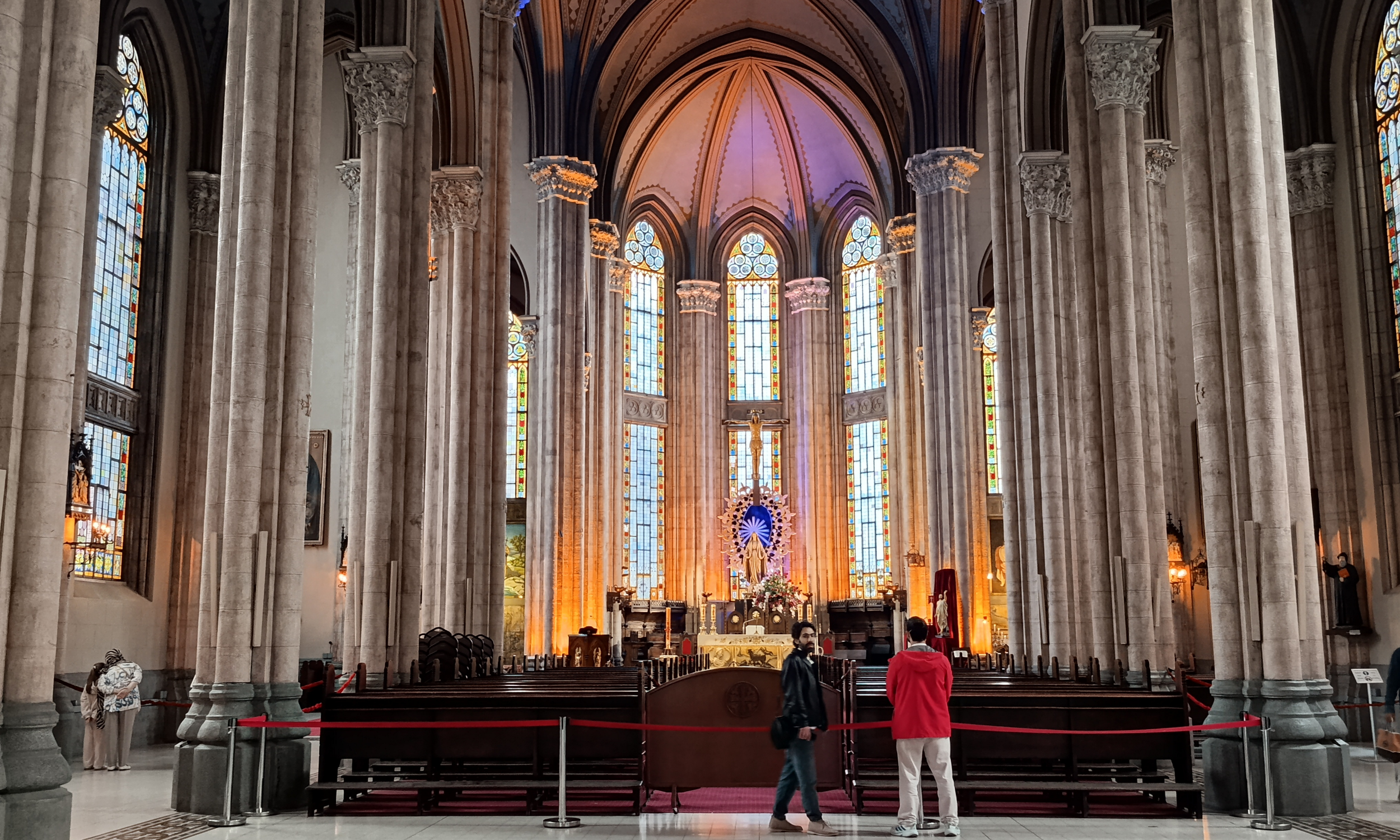
I'll be honest: the interior stopped me in my tracks in a way I didn't anticipate. After the noise of Istiklal, the street vendors, the music spilling from shop doors, the general wonderful chaos of it all, stepping inside St. Antoine felt like someone had turned down the volume on the world.
The space is grand but not cold. The ceilings are vaulted and painted a deep, soft blue, which gives the whole interior an unexpectedly warm and uplifting quality. Light filters in through stained glass windows depicting saints and biblical scenes, scattering pools of colour across the stone floors and wooden pews throughout the day. The large rose window is particularly beautiful in the afternoon, when the sunlight hits it directly.
The high altar is made of fine marble and sits in a semi-circular apse decorated with religious frescoes. The stone pillars have ornate carved details at their tops. The overall effect is one of genuine grandeur, this is, after all, the largest Roman Catholic church in Istanbul, but there's also an intimacy to it. People were praying when I visited. The church is still very much alive and in active use.
More Than a Tourist Attraction
St. Antoine is not a museum. Mass is held here regularly in Italian, Polish, English, and Turkish, reflecting the remarkable diversity of Istanbul's Catholic community. The church is still run by Italian priests, maintaining a direct connection to the Italian Franciscan community that has been part of this neighborhood for centuries.
That living quality is part of what makes it so worth visiting. You're not just looking at architecture; you're stepping into a space that has been central to a community's life for three hundred years, that survived the fall of an empire, the birth of a republic, and the transformation of an entire city around it.
Practical Notes for Your Visit
St. Antoine is at Istiklal Caddesi No. 171, in Beyoğlu. It's about a five-minute walk from Taksim Square, on the right side of the avenue as you walk toward Galatasaray. You can also reach it via the M2 metro line, the Şişhane station is slightly closer. Entry is free, though donations are of course welcomed.
The church is open to visitors outside of Mass times, so it's worth checking the schedule if you want to visit quietly. Dress modestly, as you would for any active place of worship.
Don't Walk Past It
Istanbul rewards the people who slow down. It's a city full of layers — Byzantine, Ottoman, European, modern — and St. Antoine is one of those places where several of those layers are visible at once: the Italian community that shaped Beyoğlu, the cosmopolitan Ottoman city, the enduring presence of faith across centuries of change.
I almost walked past it. I'm really glad I didn't.
If you find yourself on Istiklal Caddesi, and at some point you will, because everyone ends up on Istiklal Caddesi, step through the gates. Give yourself ten minutes in that blue-ceilinged quiet. It's one of the most unexpectedly moving things you can do in this city.
Or just book this unforgettable tour
FAQ
-
Yes. St. Antoine Church on Istiklal Caddesi is open to visitors of all faiths outside of Mass times. Entry is free. Visitors are asked to dress modestly as a matter of respect for an active place of worship.
-
St. Antoine Church — officially the Church of Saint Anthony of Padua — on Istiklal Caddesi in Beyoğlu is the largest Roman Catholic church in Istanbul. It is also known as Sent Antuan Kilisesi in Turkish and Sant'Antonio di Padova in Italian.
-
St. Antoine Church is a five-minute walk from Taksim Square along Istiklal Caddesi. Walk in the direction of Galatasaray and you will find the church on your right at No. 171. If taking the metro, the Şişhane station on the M2 line is the closest stop.
-
The current building was designed by Giulio Mongeri, a Levantine architect born in Istanbul and a professor at the city's Academy of Fine Arts. Construction ran from 1906 to 1912. The style is Italian neo-Gothic with Tuscan-Lombard influences. The church was originally founded on this site in 1725 by Istanbul's Italian community.
-
Mass is celebrated in four languages: Italian, Polish, English, and Turkish. The church is run by Italian priests and serves Istanbul's diverse Catholic community.
-
Pope John XXIII served as the Vatican's apostolic delegate to Turkey for ten years before his election as pope, and he preached regularly at St. Antoine Church during that time. He reportedly loved Istanbul deeply and spoke Turkish fluently, earning the nickname The Turkish Pope. A statue commemorating him stands in the church's courtyard.